Friday, October 3, 2025

AAVE Breaks Resistance as DeFi Market Hits Record $219B Size

Aave (AAVE), the native token of the largest decentralized finance (DeFi) lending protocol, strongly rebounded from last week's lows breaking through key resistance levels on Friday afternoon.

The token gained another 2% over the past 24 hours and is up 6% this week. It has established support at the $284-$285 levels, while it's currently consolidating around $290.

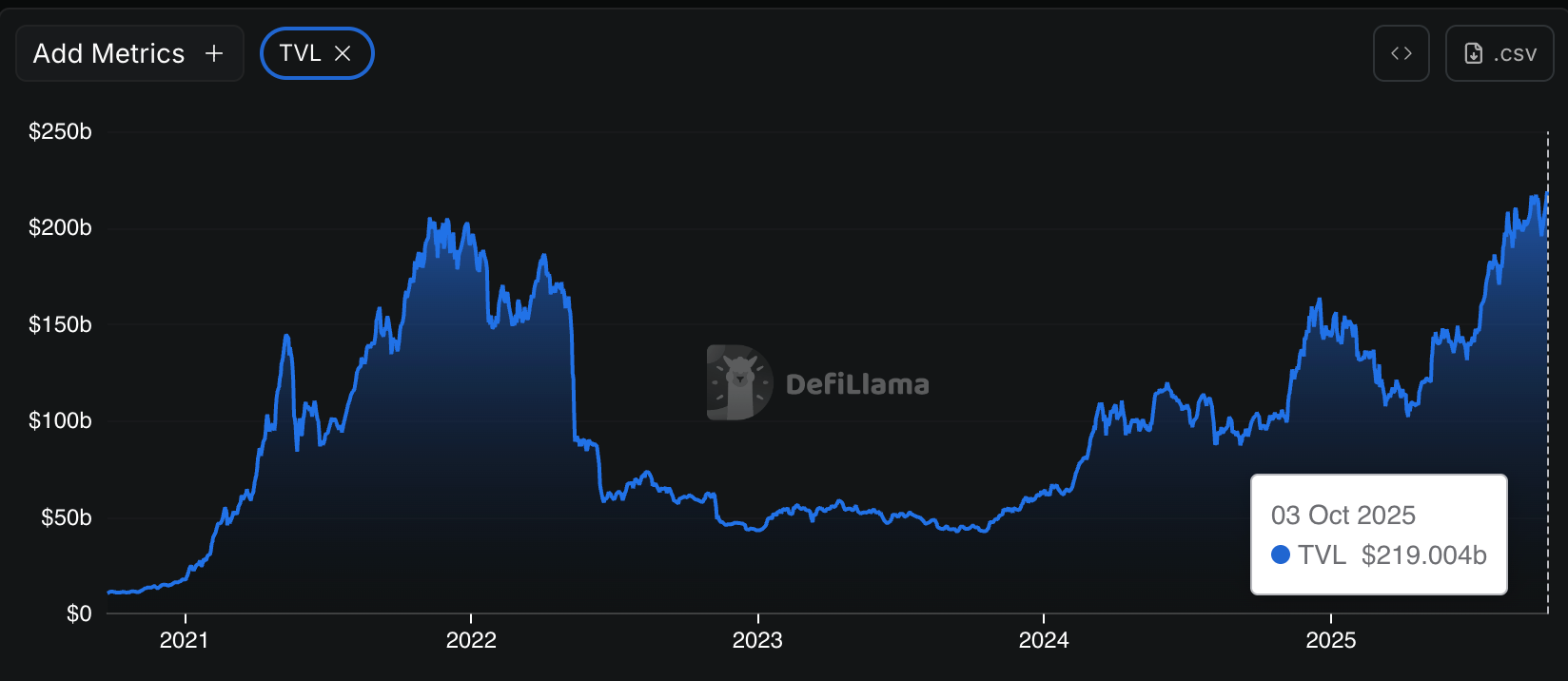
The move occurred as the broader crypto market rallied, with gains across the board and bitcoin (BTC) breaking above $122,000, inching closer to its August record high. The broader DeFi market also accelerated, hitting a $219 billion in assets across protocols, a fresh record level, DeFiLlama data shows.

DeFi total value locked as of October 3 (DeFiLlama)

Deposits on Aave also climbed to a record $74 billion, cementing its top position among DeFi protocols, per DeFiLlama data. The platform enjoyed fresh inflows due to a recent partnership with up-and-coming stablecoin-focused chain Plasma. The Plasma lending market on Aave swelled above $6 billion in less than a week.

Technical Analysis Shows Strong Momentum

Technical indicators point to upside potential despite short-term profit-taking pressure at current levels, the CoinDesk Data research model shows. However, resistance levels hold firm between $290-$294 following repeated rejections.

  • Price gains 2.33% in 24-hour session.
  • Trading range spans $15.17 between $279.16 and $294.33 extremes.
  • Volume spikes to 143,188 units, well above 37,000 average.
  • Support level confirmed at $284-$285.
  • Resistance zone established between $290-$294.
  • Intraday high reaches $290.37 before reversal.
  • Consolidation pattern develops at current levels.


source https://www.coindesk.com/markets/2025/10/03/aave-breaks-resistance-as-defi-market-hits-record-usd219b-size

Thursday, October 2, 2025

Hyperliquid Still Best-Positioned Perp DEX Despite Aster’s Surge, DeFi Analyst Says

A new thesis from DeFi analyst Patrick Scott argues that despite losing market share to rivals, Hyperliquid remains the most investable decentralized exchange for perpetual futures.

Perp DEX market in flux

Perpetual futures — or perps — are crypto derivatives that allow traders to speculate on prices without an expiry date. The decentralized platforms that host them, known as perp DEXes, have surged in popularity as traders move activity away from centralized exchanges (CEXes) such as Binance.

Scott noted that perp DEXes have expanded from less than 2% of CEX perpetual trading volume in 2022 to more than 20% last month. Hyperliquid, which issues the HYPE token, has been a key driver of that growth.

Still, recent shifts have raised questions. Hyperliquid’s share of perp DEX volume fell from 45% to just 8% in recent weeks, while Binance-affiliated rival Aster ballooned to more than $270 billion in weekly trades. Other upstarts such as Lighter and edgeX also posted triple-digit percentage gains in activity.

Why Hyperliquid still stands out

Scott argued that Hyperliquid’s fundamentals set it apart. The exchange continues to generate strong revenue, trading at what he described as a reasonable multiple compared to peers, with user stickiness reflected in open interest.

“Unlike volume and revenue, which measure activity, open interest measures liquidity. It’s much stickier,” he wrote, noting Hyperliquid still commands about 62% of the perp DEX open interest market.

Beyond trading, Scott highlighted expansion plans including the HyperEVM network, already hosting over 100 protocols and $2 billion in total value locked and USDH, a stablecoin backed by reserves held with BlackRock and Superstate.

Another initiative, HIP-3, would allow builders to launch new perps markets by staking large amounts of HYPE, creating what Scott described as a “supply sink” for the token.

Scott cautioned that his thesis would be invalidated if Hyperliquid’s open interest or revenue dropped materially, or if USDH failed to gain liquidity over the next year. But for now, he maintains Hyperliquid is better positioned than competitors running heavy incentive programs.


source https://www.coindesk.com/markets/2025/10/03/hyperliquid-still-best-positioned-perp-dex-despite-aster-s-surge-defi-analyst-says

White House Weighing Candidates for Multiple CFTC Spots: Former Chairman Giancarlo

Though the U.S. Commodity Futures Trading Commission's Acting Chairman Caroline Pham has been blazing forward on crypto-friendly policy, even as she has one foot out the door, the White House is working quickly to find a permanent successor after abandoning President Donald Trump's first choice.

Trump nominee Brian Quintenz, a former commissioner, was dropped recently, and the administration has since been "hard at work" on announcing a new choice, said former CFTC Chairman Chris Giancarlo, who added that he was at the White House on Wednesday.

"The White House felt that they had things in hand; it didn't work out," Giancarlo said in an interview on CoinDesk TV. "I'm very optimistic that soon we will have nominees that everyone will say, 'Wow, great choices.'"

Giancarlo — a longtime crypto advocate sometimes known in the industry as "Crypto Dad," a name he used as the title of a book he wrote on the digital assets movement — said the White House is vetting CFTC candidates beyond the chairmanship. Without a slate of commissioners, whoever takes over from Pham would be alone at the commission, which is meant to have five members by law. Policies instituted by a single-member commission could be vulnerable to legal challenges.

"They're very aware of this," Giancarlo said. "They know what they've got to do."

A top contender for the chairmanship is Mike Selig, who has been working as a senior official on crypto policies at the Securities and Exchange Commission, according to people familiar with the vetting. Any nominees still need confirmation from the U.S. Senate before they can take the jobs — a process that stalled mid-stream with Quintenz after he was openly opposed by Gemini CEO Tyler Winklevoss.

The CFTC is likely to be a leading regulator of U.S. crypto markets, especially if the Senate completes and passes market structure legislation that's already cleared the House of Representatives. That effort would give new powers to the smaller cousin of the SEC, granting it jurisdiction over the spot markets where crypto commodities such as bitcoin trade directly. Though the SEC has been moving quickly into a crypto-cheering posture under Trump, the CFTC had a deep history with the sector since its 2015 move to recognize bitcoin as a commodity.

Earlier this week, Pham sought to assure financial-sector lawyers that the CFTC is moving forward fine under her temporary leadership, though she's also said she's hoping to leave the agency soon. Giancarlo said she is owed a "debt of gratitude" for what she's doing, much of which has been focused on a "crypto sprint" she's offered to match the SEC's Project Crypto agenda.

While the shorthanded CFTC awaits new leadership, the Senate has been slowed by the federal government shutdown and is showing few signs of a near-term completion of the industry legislation.

Representative Bryan Steil, the chairman of the crypto subcommittee within the House Financial Services Committee, said in a separate interview on CoinDesk TV that the current goal is "getting this completed as soon as possible, but no later than the end of the year." That's slipped considerably from Trump's initial deadline of August.

The House had already passed its version this year — the Digital Asset Market Clarity Act — with an overwhelming bipartisan vote. Steil argued the Senate can save a lot of time by "using Clarity as baseline text" for its work, though Senate Republicans proposed their own draft language and that's the text lawmakers have been working from.

Read More: U.S. SEC Takes Preliminary Step to Expand Universe of Crypto Custody to State Trusts


source https://www.coindesk.com/policy/2025/10/02/white-house-weighing-candidates-for-multiple-cftc-spots-former-chairman-giancarlo

Filecoin Rises More Than 4% Amid Wider Crypto Market Rally

Filecoin (FIL) performed strongly over the last 24 hours with a 4% gain, according to CoinDesk Research's technical analysis model.

The model showed that the token advanced from a low of $2.25 to a high of $2.38.

Sustained buying pressure persisted despite mid-session volatility around $2.31 support, according to the model.

The recovery pattern reinforced the broader bullish trajectory established throughout the 24-hour period.

On the news front, IoTeX has launched the Real World AI Foundry, a global alliance to create shared standards for AI trained on live data, which Filecoin has joined as an alignment partner, according to a post on X.

The wider crypto market also rose, with the broad market gauge, the CoinDesk 20, up 3%.

Technical Analysis:

  • FIL posts strong bullish momentum during the 24-hour period advancing from $2.25 to $2.38.
  • The token established clear support around the $2.31 level with high-volume confirmation during early morning hours.
  • Resistance emerged near $2.36 with multiple rejections earlier in the day.
  • Recent price action shows a compelling recovery pattern, as the token broke through resistance at the $2.36 level.

Disclaimer: Parts of this article were generated with the assistance from AI tools and reviewed by our editorial team to ensure accuracy and adherence to our standards. For more information, see CoinDesk's full AI Policy.


source https://www.coindesk.com/markets/2025/10/02/filecoin-rises-more-than-4-amid-wider-crypto-market-rally

Wednesday, October 1, 2025

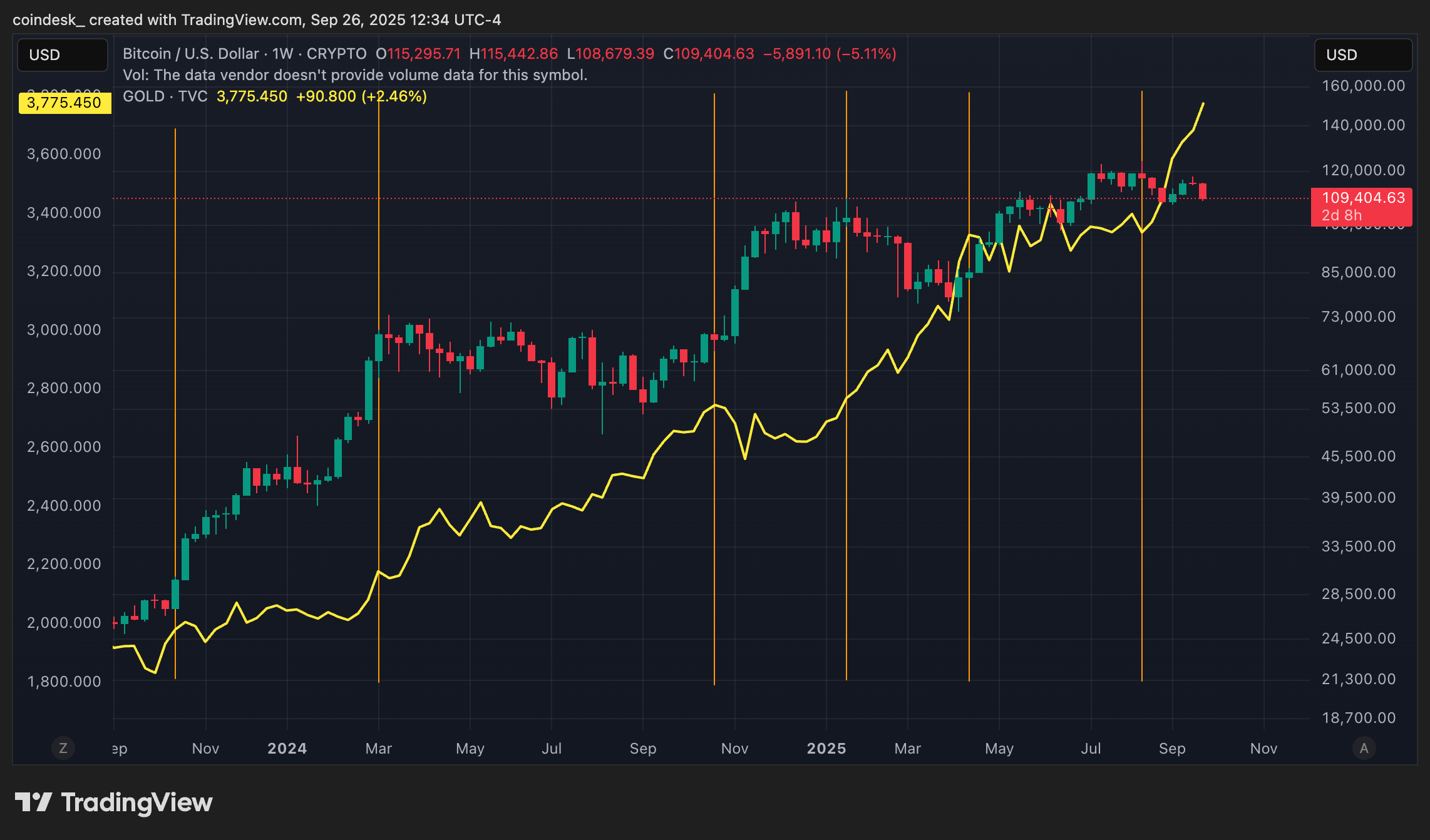
When Could Bitcoin Break Out to New Highs? Watch Out for Gold

Stocks printed fresh records and gold is on a tear crossing $3,900, but the last leg higher in traditional markets left bitcoin (BTC) behind.

The largest crypto, often touted as digital gold, has been stuck in a $100,000–$120,000 range for nearly three months after setting new highs in July and August.

The lag fits a pattern. Over the past couple of years, gold and bitcoin have taken turns: when gold breaks out, bitcoin tends to consolidate; when gold cools, BTC often resumes the advance.

BTC versus gold (TradingView)

From January into April, BTC plunged about 30% while gold kicked off its next leg, rising roughly 28% to $3,500 at the height of the global tariff tantrum. Gold then stalled into August, and bitcoin took the baton, rallying about 60% from trough to peak to notch fresh records.

Bitcoin to catch up when gold tires

"Gold likes low rates and a weak economy, whereas bitcoin likes them firm," said Charlie Morris, chief investment officer at ByteTree, in a recent report. "Because bitcoin likes a super strong economy, and low rates are associated with economic slumps." He added that the BTC–gold relationship is loose: the 90-day correlation has averaged around 0.1 — "basically zero."

Right now, gold is in a lockout rally toward $4,000, up about 17% across a seven-week winning streak. Bitcoin, meanwhile, is still ranging below $120,000.

If the recent rhythm holds, a pause in gold, or even a sideways drift, could be the tell for BTC’s next break out of the range and another run at records.

"The good news for bitcoin is that sooner or later, gold will get tired," Morris said.


source https://www.coindesk.com/markets/2025/10/01/when-could-bitcoin-break-out-to-new-highs-watch-out-for-gold

Memecoins Are No Longer a Joke, Galaxy Digital Says in New Report

Memecoins, once dismissed as little more than internet jokes, have cemented themselves as a permanent fixture of the crypto economy, according to new research from Galaxy Digital.

In a report published Wednesday, research analyst Will Owens argues that the sector has matured into a cultural and economic force in its own right. Galaxy estimates digital assets tied to memes now represent a meaningful share of trading activity and investor interest, extending well beyond Dogecoin and Shiba Inu.

A cultural and trading phenomenon

Owens wrote that memecoins “capture attention and capital” by blending humor with financial speculation, making them uniquely effective at onboarding new participants into crypto.

Galaxy’s research cites the growing number of users interacting with memecoins not only as traders but also as community members who build narratives, memes and digital identities around the tokens.

On the trading side, Owens notes that memecoins consistently generate some of the highest liquidity and fee volumes in the industry, rivaling mainstream assets. Their volatility, he added, has turned them into a reliable revenue source for exchanges and liquidity providers.

Pump.fun and infrastructure shifts

One of the most striking developments highlighted in the report is the rise of Pump.fun, a Solana-based platform that lets anyone launch a memecoin in minutes. Galaxy said the service has turbocharged activity in 2025, creating thousands of new tokens and contributing to record-high fee generation on Solana.

While many of these tokens fade quickly, Owens argued the platform illustrates how memecoins are reshaping crypto’s infrastructure. He believes that by driving experimentation in token issuance, liquidity bootstrapping and trading mechanics, memecoins are helping to pressure-test blockchain ecosystems at scale.

Long-term implications

The report cautioned that most memecoins remain speculative and short-lived, but said the broader trend is undeniable: the sector is no longer a passing fad. “Memecoins are here to stay,” Owens wrote, emphasizing their ability to sustain user engagement and influence protocol economics across multiple chains.

Galaxy concludes that memecoins have moved beyond being a market sideshow, evolving into a structural component of crypto culture, trading and infrastructure.


source https://www.coindesk.com/markets/2025/10/01/memecoins-are-no-longer-a-joke-galaxy-digital-says-in-new-report

U.S. Senate Hearing on Crypto Taxes Reveals Headaches for Both Industry and IRS

A top tax executive for U.S. crypto exchange Coinbase suggested to U.S. senators at a Wednesday hearing that the Internal Revenue Service is ill equipped to handle the kind of tax reporting already in the works under current rules and that may be produced in future regulations.

"The IRS is probably unprepared today to endure or to absorb the amount of information that Coinbase alone will be providing," said Lawrence Zlatkin, vice president for tax at the exchange, during a Senate Finance Committee hearing examining the U.S. approach to taxing the crypto sector. "We're going to be testing that in a little while."

He said it's important to consider administrability — what the agency can realistically manage — as the future rules are contemplated, because "this is one asset class that is so democratized that we are talking about billions of transactions."

The Treasury Department's IRS had recently established the crypto brokerage forms that will deluge the federal tax offices, but there are several major crypto taxation questions still hanging. Some of them — such as whether to ignore any minor gains on small-scale transactions (the so-called "de minimis" exemption) or to delay the taxability of staking gains until they're sold — are at the center of congressional discussions on digital assets legislation. But it remains unclear which ones will get attention and when, leaving significant uncertainty for crypto businesses and investors.

"Our tax code does not provide straightforward answers for many digital asset transactions, whether someone is buying a cup of coffee, donating to a charity, investing, lending, mining or staking," Senator Mike Crapo, the panel's chairman, offered in summary. "Without clear tax rules, taxpayers are left with many unanswered questions."

Though many of the panel's Democrats focused some of their remarks on the federal government shutdown heading into its first day on Wednesday, they also devoted attention to what they characterized as the industry's longstanding avoidance of U.S. taxes on gains and — in Senator Elizabeth Warren's case, the efforts of crypto lobbyists who "want special tax rules for crypto that will make crypto billionaires richer."

While Senator Ron Wyden, the Oregon lawmaker who is the committee's ranking Democrat, granted that the crypto sector needs Congress' attention on tax matters, he added that "there’s a pretty long list of major issues and problems this committee ought to look at first."

Meanwhile, the IRS has been a particular target of the administration, which has cut thousands of staff from its workforce. While the agency has recently maintained a crypto office, its top officials have abandoned it — most recently with the departure of Trish Turner — and the IRS hasn't responded to CoinDesk questions about the office's ongoing status.

Among the crypto industry's chief asks are that de minimis transactions be exempted from tax hassles, certain rewards stop being treated as income when first issued and that stablecoins should also be exempted from gain considerations, because they're meant to reflect the value of a dollar.

In July, Senator Cynthia Lummis — the Wyoming Republican who leads the crypto subcommittee of the Senate Banking Committee — introduced a standalone bill that would address many of the industry top tax concerns, including setting a $300 de minimis threshold. But it's unclear what the Senate will do with those ideas.

Earlier on Wednesday, prominent crypto firms began praising new guidance that just emerged from the IRS, potentially freeing them from certain tax burdens.

Strategy's Michael Saylor posted on social media site X that the IRS guidance means his company "does not expect to be subject to the Corporate Alternate Minimum Tax (CAMT) due to unrealized gains on its bitcoin holdings." And bitcoin mining company MARA similarly called it "a positive development for MARA and our shareholders."

But even that possible boon came from initial guidance — a tentative document signaling a likely future policy that's not yet enacted.

Read More: U.S. Digital Assets Tax Policy Getting Hearing During 'Crypto Week'


source https://www.coindesk.com/policy/2025/10/01/u-s-senate-hearing-on-crypto-taxes-reveals-headaches-for-both-industry-and-irs
Bitcoin holders risk losing real BTC if they sell coins from BIP-110 fork, says developer

If a minority chain appears this weekend, buyers could replay signed fork-coin sales on bitcoin itself, making doing nothing the safest move...