Friday, August 22, 2025

Ethereum Surges to New All-Time High Amid Likely September Rate Cut

Ethereum (ETH) hit a record price of $4,885 on Coinbase on Friday after a speech by Federal Reserve Chair Jerome Powell suggesting interest rate cuts left traders relieved going into the weekend.

The token rose nearly 15% over the past 24 hours as part of a broader rally in financial markets.

Nevertheless, ether’s rally stood out among other tokens. Bitcoin was also up, but only by about 4%. The CoinDesk 20 Index, which tracks the broader crypto market, rose 9% over the same period.

Powell on Friday gave hints that the Fed will indeed cut interest rates in September, as initially anticipated by traders. Hope, however, faded over the last few days, causing a significant reaction in global markets during Friday trading hours.

Ether has not only profited from macroeconomic circumstances this year, but even more so from renewed institutional interest in the network behind the token.

Several companies have started accumulating ether as part of their treasury strategy, including ETHZilla that is backed by billionaire investor Peter Thiel. Some believe that Ethereum will eventually be Wall Street’s favorite blockchain to build on, fueling demand for its native token.

As a result, ether has outperformed bitcoin this year, up about 45% since the start of 2025 while the largest cryptocurrency is up 25%. Some other ether-related tokens, such as Lido (LDO) and Ethena (ENA), also benefited from ETH's swift rally.


source https://www.coindesk.com/markets/2025/08/22/ethereum-surges-to-new-all-time-high-amid-likely-september-rate-cut

Head of IRS Crypto Work Exits as U.S. Tax Changes Loom For Digital Assets

The head of the U.S. Internal Revenue Service's digital assets unit, Trish Turner, is leaving her post for the private sector just as new tax policies are set to potentially bring in a wave of crypto work for the agency.

As she departs, it's unclear who will be running the office that's been leading the tax agency's crypto work as a major shift in U.S. digital assets taxation is on the horizon. Turner's exit comes after the IRS set several new rules and forms in motion to direct taxation requirements for individual crypto investors and their brokers. And the departure comes after two other top officials on crypto work, Seth Wilks and Raj Mukherjee, already left through the Trump administration's budget-slashing campaign earlier this year.

The tax arm of the Treasury Department is poised to experience a massive influx of crypto-sector filings while it's also weathering deep budget and staffing cuts in excess of 20,000 employees. IRS staffing — long a target of Republican lawmakers — has experienced a long-term decline from about 113,000 three decades ago to about 76,000 at a recent count.

One of the major crypto changes at the IRS was the new 1099-DA form that millions of investors will be receiving from their crypto brokers. About 3 million taxpayers have previously disclosed they had crypto transactions — a number that's likely much higher in reality, setting up a potential glut of newly disclosed crypto taxpayers as the policies come online. The IRS didn't respond to questions about Turner's departure and who will take over.

"Digital assets have shifted from a niche issue to a core focus for global regulators, and I am proud to have helped lay the foundation for oversight in this fast-changing space,” Turner said in a statement to CoinDesk. “Now, I’m excited to be moving to the other side of the table to help taxpayers, businesses, and institutions understand their obligations and navigate those same rules with confidence."

Among the private-sector roles she's taking on, Turner will be tax director at the firm CryptoTaxGirl, a tax business that specializes in crypto transactions, and will also do work with the UK firm Asset Reality, she said.

Laura Walter, CTG's founder, said in a statement that Turner's arrival will help "ensure our clients receive the highest level of guidance, protection, and confidence in their filings."

For years, crypto investors and businesses have struggled through U.S. tax uncertainties, with no third-party documentation to make their tax-filing requirements clear. So a large segment of digital assets holders have skipped their crypto tax calculations in past years, further muddying the water for the IRS.

Because the new 1099-DA forms will be flowing from crypto investors' accounts at such firms as Coinbase and Kraken early next year, those recipients will be under increased pressure to work out and disclose their tax positions. But one IRS rule that sought to treat certain decentralized finance (DeFi) platforms as brokers was overturned by Congress in April, leaving treatment of that corner of the crypto sector on less certain ground.Read More: The Coming Crypto Tax Bomb


source https://www.coindesk.com/policy/2025/08/22/head-of-irs-crypto-work-exits-as-u-s-digital-assets-tax-changes-loom

VanEck Aims to Take Solana's Liquid Staking to TradFi Investors Via JitoSOL ETF

Asset manager VanEck has filed to launch a staked solana (SOL) exchange-traded fund (ETF), signaling continued interest in bringing blockchain-native yield-bearing assets to traditional investment rails.

The application, submitted Friday as an S-1 registration with the U.S. Securities and Exchange Commission (SEC), is the first of two filings required to list the fund. If approved, the ETF would hold JitoSOL, a liquid staking token native to the Solana blockchain. JitoSOL reflects ownership of SOL tokens that have been staked and also accrues the staking rewards earned by those tokens.

Unlike traditional ETFs, this product would not just track the price of SOL but also the income generated by staking — effectively baking Solana’s yield into a publicly traded product.

The SEC has been in ongoing discussions with ETF providers, including VanEck, about whether staking components can be integrated into existing and proposed crypto investment funds.

Regulatory bottlenecks

Speaking at an industry panel in Jackson Hole earlier this week, SEC Chair Paul Atkins said the Commission is looking to clear regulatory bottlenecks that slow innovation.

“There’s a lot of spring cleaning that needs to be done at the SEC,” he said. “We cannot have things so abstruse that lawyers can’t give opinions to clients.”

Atkins said the agency’s future rules should be flexible and designed to evolve. He added that the SEC wants to continue its legacy of adapting to new technologies, hinting at a more open stance toward crypto asset products like liquid staking ETFs.

VanEck joins a number of asset managers looking to launch a staked solana fund, including Fidelity, Grayscale and Franklin Templeton.


source https://www.coindesk.com/markets/2025/08/22/vaneck-aims-to-take-solana-s-liquid-staking-to-tradfi-investors-via-jitosol-etf

Thursday, August 21, 2025

Japan's SBI Holdings Joins Tokenized Stock Push With Startale Joint Venture

Japanese financial giant SBI Holdings is moving into the red-hot tokenized stock market through a joint venture with Singapore-based blockchain development firm Startale.

The companies plan to build an on-chain platform designed for trading tokenized equities and real-world assets (RWAs), they announced on Friday.

The step puts SBI alongside a growing roster of major players experimenting with tokenized stocks. Robinhood and several crypto exchanges including Kraken, Gemini started offering blockchain-based versions of publicly traded shares.

SBI, which oversees more than 11 trillion yen ($74 billion) in assets and has over 65 million customers globally, sees asset tokenization as a major shift in global markets.

"We predict that this movement will eventually lead to the digitalization of capital markets themselves, including exchanges," Yoshitaka Kitao, president and CEO of SBI Holdings, said in a statement.

The joint venture will focus on 24/7 trading of tokenized U.S. and Japanese stocks with near-instant settlement, the press release said. Features are expected to include fractional ownership, institutional-grade custody and real-time compliance monitoring.

"This platform will be highly interoperable, always open, accessible to anyone, and designed to meet the needs of users worldwide in the global market," Yoshitaka Kitao said.

Startale previously developed Soneium, an Ethereum layer-2 network, with Japanese tech giant Sony.

Read more: DBS Launches Tokenized Structured Notes on Ethereum, Expanding Investor Access


source https://www.coindesk.com/

U.S. Justice Department Official Says Writing Code Without Bad Intent 'Not a Crime'

A senior official at the U.S. Department of Justice knew the crypto audience in Wyoming had fresh software developer convictions on its mind when he told them on Thursday that his department doesn't want to go after digital assets software developers who don't have money-laundering intentions.

Matthew Galeotti, acting assistant attorney general in the DOJ's criminal division, made those assurances at an event hosted by the new crypto group American Innovation Project, drawing vigorous applause.

"The department will not use federal criminal statutes to fashion a new regulatory regime over the digital asset industry," he said. "The department will not use indictments as a lawmaking tool. The department should not leave innovators guessing as to what could lead to criminal prosecution."

He added that "merely writing code without ill intent is not a crime."

Those sentiments arrive against the backdrop of a couple of recent courtroom developments in which U.S. prosecutors won convictions against crypto developers. Most prominently, Tornado Cash developer Roman Storm was found guilty of running an unlawful money transmitting business.

That followed closely on the heels of a plea agreement involving the developers behind Samourai Wallet pleading guilty to conspiracy to operate an unlicensed money transmitting business — a significantly lesser charge to what they'd originally faced.

Galeotti directly addressed concerns about that specific criminal code they were all convicted under. He said the DOJ wouldn't use it in crypto cases unless prosecutors have "evidence that a defendant knew of the specific legal requirements and willfully violated it."

He said new charges won't be pressed under that code in cases in which "software is truly decentralized and solely automates peer-to-peer transactions, and where a third party does not have custody and control over user assets."

An April memo issued by Deputy Attorney General Todd Blanche had set out the stance of the department under the leadership appointed by U.S. President Donald Trump. It noted the national cryptocurrency enforcement team had been disbanded and said the DOJ would take a careful approach to crypto cases after the previous administration "created a particularly uncertain regulatory environment around digital assets." Despite the Blanche memo, the Southern District of New York (SDNY) pressed forward with their cases against Storm and the Samoruai Wallet developers.

"Developers of neutral tools with no criminal intent should not be held responsible for someone else's misuse of these tools," Galeotti said at the Thursday event, the first held by the AIP that was launched this week. "If a third party's misuse violates criminal law, then that third party should be prosecuted, not the well-intentioned developer."

The protection of crypto software developers has been a central lobbying point for the industry in its negotiations with lawmakers and regulators in Washington. The crypto market structure legislation currently moving through Congress has included protections of such developers, though the final version isn't yet set in the Senate.

"The fact that the DOJ acknowledged that software developers should not be held responsible for third parties' misuse of their code affirms what we have been advocating for years," said Amanda Tuminelli, executive director of the DeFi Education Fund, in a statement after Galeotti's remarks. "Let's celebrate this as a moment of progress and remember that there is still more work to be done to change the law permanently."

Read More: DOJ Axes Crypto Unit as Trump’s Regulatory Pullback Continues


source https://www.coindesk.com/policy/2025/08/21/u-s-justice-department-official-says-writing-code-without-bad-intent-not-a-crime

State Street Expands Custody to Tokenized Debt on JPMorgan’s Blockchain Platform

State Street, a Boston-based custody bank with $49 trillion in assets under its watch, is pushing deeper into digital assets by joining JPMorgan’s blockchain-based tokenized asset platform Digital Debt Service as the first third-party custodian.

The first transaction State Street anchored was a $100 million tokenized commercial paper issuance by the Oversea-Chinese Banking Corporation (OCBC), a Singapore-based banking group, according to a Thursday press release.

State Street Investment Management, the bank's asset management arm, purchased the debt. J.P. Morgan Securities acted as placement agent.

The move comes as traditional finance heavyweights and global banks are getting increasingly involved in tokenization of financial instruments, or real-world assets (RWA), placing bonds, funds and credit on blockchain rails. The process promises operational benefits such as increased efficiency, faster and around-the-clock settlements and lower administrative costs.

The tokenized asset market could grow could balloon in the next few years, though projections vary from McKinsey's $2 trillion by 2030 to Ripple and BCG's almost $19 trillion by 2033.

By joining JPMorgan's blockchain platform, State Street can now offer clients custody of tokenized debt securities without changing its traditional servicing model.

In this particular case, State Street manages client holdings in a digital wallet directly connected to JPMorgan’s system, eliminating manual steps in settlement and recordkeeping. The infrastructure supports delivery-versus-payment settlement, with the option for same-day (T+0) settlement, and automates corporate actions such as interest payments and redemptions through smart contracts.

"This launch reflects a meaningful step forward in our digital strategy — where we manage a digital wallet on-chain and lay the groundwork for interoperability across blockchain networks," Donna Milrod, State Street's chief product officer, said in a statement.

The bank pursued initiatives to tokenize a bond and a money market fund, Milrod said in October. The firm also selected Switzerland-based Taurus as a tokenization partner.

Read more: DBS Launches Tokenized Structured Notes on Ethereum, Expanding Investor Access


source https://www.coindesk.com/business/2025/08/21/state-street-expands-custody-to-tokenized-debt-on-jpmorgan-s-blockchain-platform

Victim Loses $91M in Bitcoin in Social Engineering Scam: ZachXBT

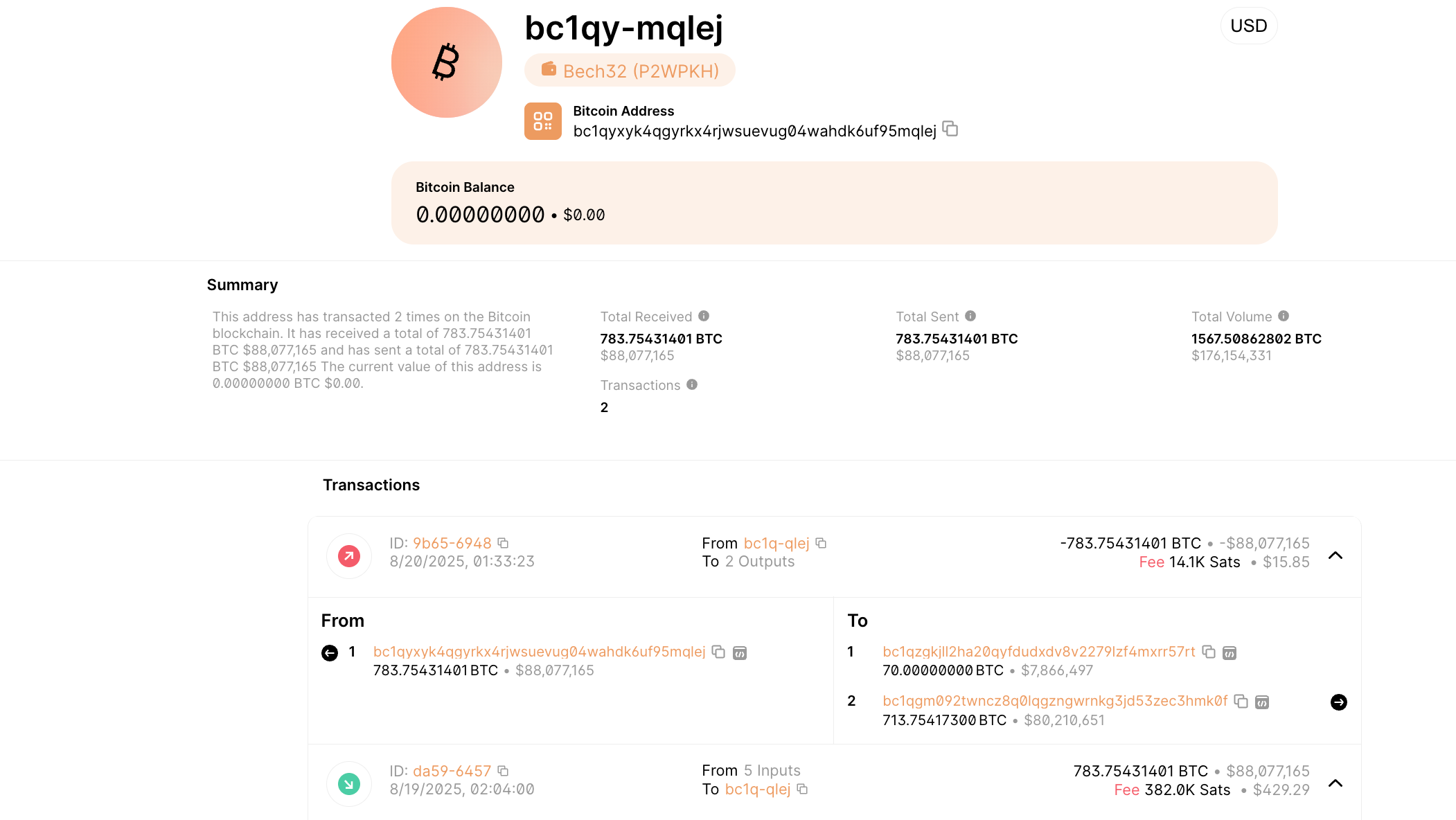
Blockchain sleuth ZachXBT uncovered a high-profile social engineering attack on Thursday, with the victim losing 783 BTC worth around $91.4 million.

The scam occurred on Aug. 19 and involved the attacker posing as a support agent for a hardware wallet before duping the victim into handing over wallet credentials.

The attack mirrors a string of social engineering attacks over the past year and contributes to an already woeful year in terms of hacks and scams, with crypto investors losing $3.1 billion in the first half of 2025.

Theft wallet (Blockchain.com

Once the malicious transfer was made, the funds began their journey through a typical laundering process, with multiple deposits made into Wasabi Wallet, a privacy tool commonly used to obfuscate the trail.

The hack occurred exactly one year after the $243 million Genesis creditor theft, a landmark event that sent ripples across the industry and led to the arrest of 12 people in California in May.


source https://www.coindesk.com/business/2025/08/21/victim-loses-usd91m-in-bitcoin-after-social-engineering-scam-zachxbt

U.S. regulator warns about cheating risks in 'mention markets' on prediction platforms

The Commodity Futures Trading Commission issued a new advisory to flag the unique dangers of markets based on individuals' behavior. so...